Hands-on math
I like teaching mathematics with real problems and real data: a jellyfish pulse, a heart rhythm, a horse's stride. Most of what we build for teaching is free to use.
Courses at the University of Arizona
| MATH 481 | Mathematical Modeling of Fluid Flow through and around Organs and Organisms |
| MATH 119A | Calculus for Life Sciences |
| ACBS 272 | Introduction to Horsemanship |
| MATH 223 | Vector Calculus |
| MATH 577 | Introduction to Theoretical Fluid Dynamics |
| MATH 581A | Methods of Applied Mathematics I |
| HSP | Horses in Motion: A History of the Biomechanics of Movement (Humanities Seminars Program) |
Research with students
- Horse and Math Innovation Lab. A Vertically Integrated Project where students from many majors work together for several semesters on horse movement and physiology.
- Course-based research in equine biomechanics. A class where every student does original research: collecting data, analyzing it, and building models.
- Summer REU. Our Research Training Group in Data Driven Discovery, with support from the Provost Investment Fund, runs a summer program that pairs mathematics and data science with equine science.
- Independent study. MATH 199 to 499, at any level.
Free apps and lessons
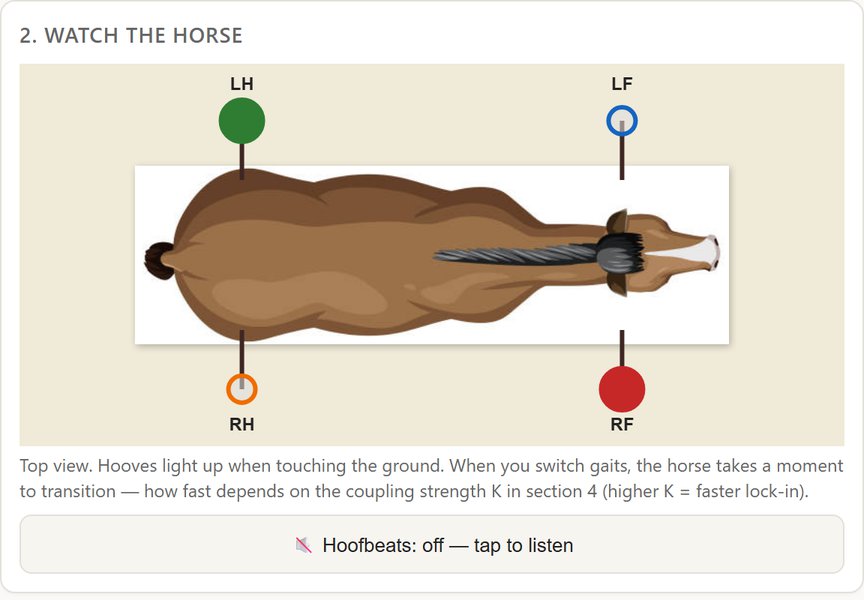
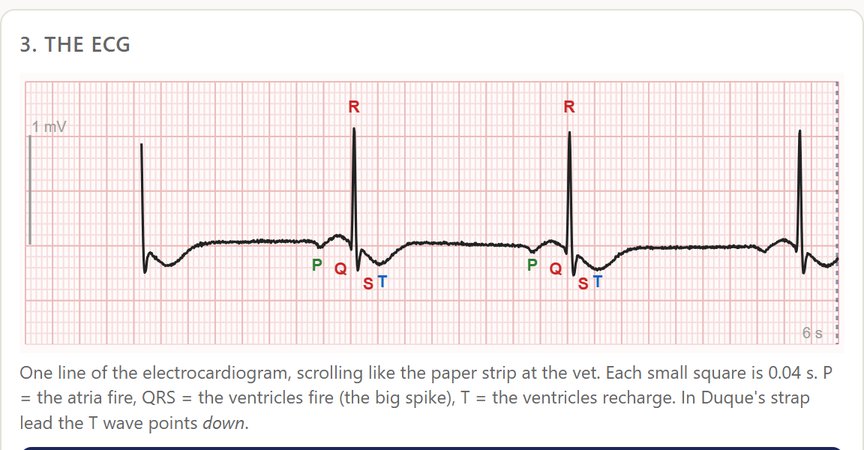
Built from our own horses' data, for elementary school through college. Everything runs in a browser.
Tutorials
Free tutorials on immersed boundary methods that I've developed over the past 12 years, from the theory to running simulations in IB2d and IBAMR. Please let me know if you find any issues or have suggestions for extensions.
Fluid Dynamics and IBM Theory
From deriving the Navier–Stokes equations to the immersed boundary method, solid mechanics for IBFE, and turbulence.
Fluid Dynamics and IBM TheoryUsing IB Software
Hands-on tutorials for IB2d, IBAMR (including IBFE), VisIt, and Planktos, with example codes. A consolidated, updated version is in progress.
Using IB SoftwareCode
Most of our simulations use the immersed boundary method, first developed by Charles Peskin. For flows at very small scales, where viscosity wins, we also use regularized Stokeslets. These are the tools we use and share.
Fluidlets
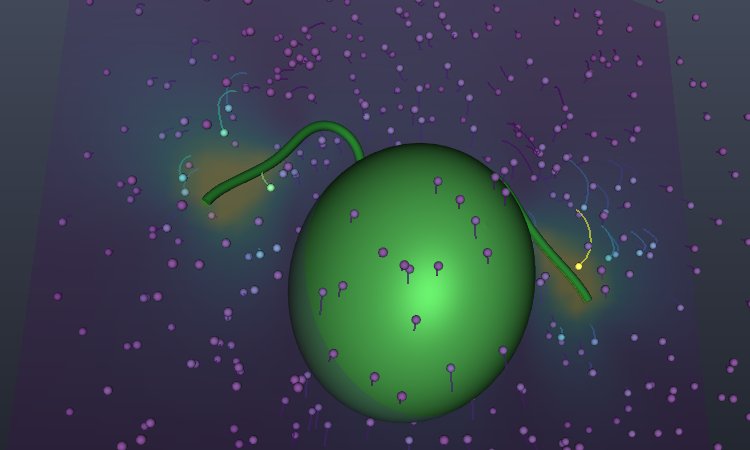
Regularized Stokeslets for cells, cilia, and swimmers, with walls, IB2d-style input files, ParaView output, worked examples, and tutorials. The software goal of our NSF FRG with Michael Minion, Jan Prins, and Jingfang Huang.
github.com/fairyflies9/fluidletsIB2d
An easy-to-use immersed boundary code in 2D with dozens of examples: springs, beams, muscles, porous structures, and advection-diffusion. Led by Nick Battista.
github.com/nickabattista/IB2dIBAMR
Boyce Griffith's adaptive, parallel immersed boundary library for 3D problems. We share our tutorials, slides, and example models.
Using IB Software tutorialsIBAMR on GitHubPlanktos
An agent-based framework for moving plankton and other small organisms through simulated flows, developed with Christopher Strickland.
Planktos on GitHubCFD for biologists
Codes and data for "Using computational fluid dynamics to understand fluid-organism interaction."
JEB-CFD-ReviewOutreach and service
- Organizer of the International Cassiopea Workshop, which brings together people who study upside-down jellyfish, from genes to fluid dynamics.
- Organizer of the Systems Biomechanics of the Horse symposia and the 2026 workshop on horse and human partnership.
- Organizer of Dynamics Days 2026 at the University of Arizona.
- Coach for the Faculty Success Program of the National Center for Faculty Development and Diversity.
- Section editor for Mathematical and Computational Fluids, Fluids.
- Public talks and demos with EquiPhysics. See what's coming up.